Space Mirrors team continues to bamboozle the press
The problem is not that space mirrors are dangerous; it's that the stated plan can't work. It's all about the physics.

There’s this thing called Space Mirrors, ummm, it’s officially called Reflect Orbital, a company that is proposing to put mirrors in space that would reflect sunlight to solar panels on Earth, whose electricity they’re proposing to sell for $5000 an hour.
The trouble is that, as University of Oregon physics professor Raghu Parthasarathy has explained, some very basic physics calculations, along with a bit of economics (the current price of electricity), shows that the electricity would only be worth $72 an hour. Actually this is based on a lot of favorable assumptions; in real life much less electricity would be delivered, and so the output would be worth much less than $72/hour.
So, yeah, their business plan to sell this for $5000/hour won’t work. It violates some combination of the laws of physics and economics. There’s no reason to pay $5000 for power that you could get on the open market for less than $72.
Actually, $72 is a huge overestimate. Raghu has an update where he brings on the physics:
No matter what sort of mirror or lens you make (and go to the trouble of installing in space), the universe constrains how tightly it can focus light. . . . For a mirror collecting sunlight, that input spread is determined by the apparent width of the sun, and therefore the ratio of the sun’s diameter (dsun) to the distance to the sun (Lsun):
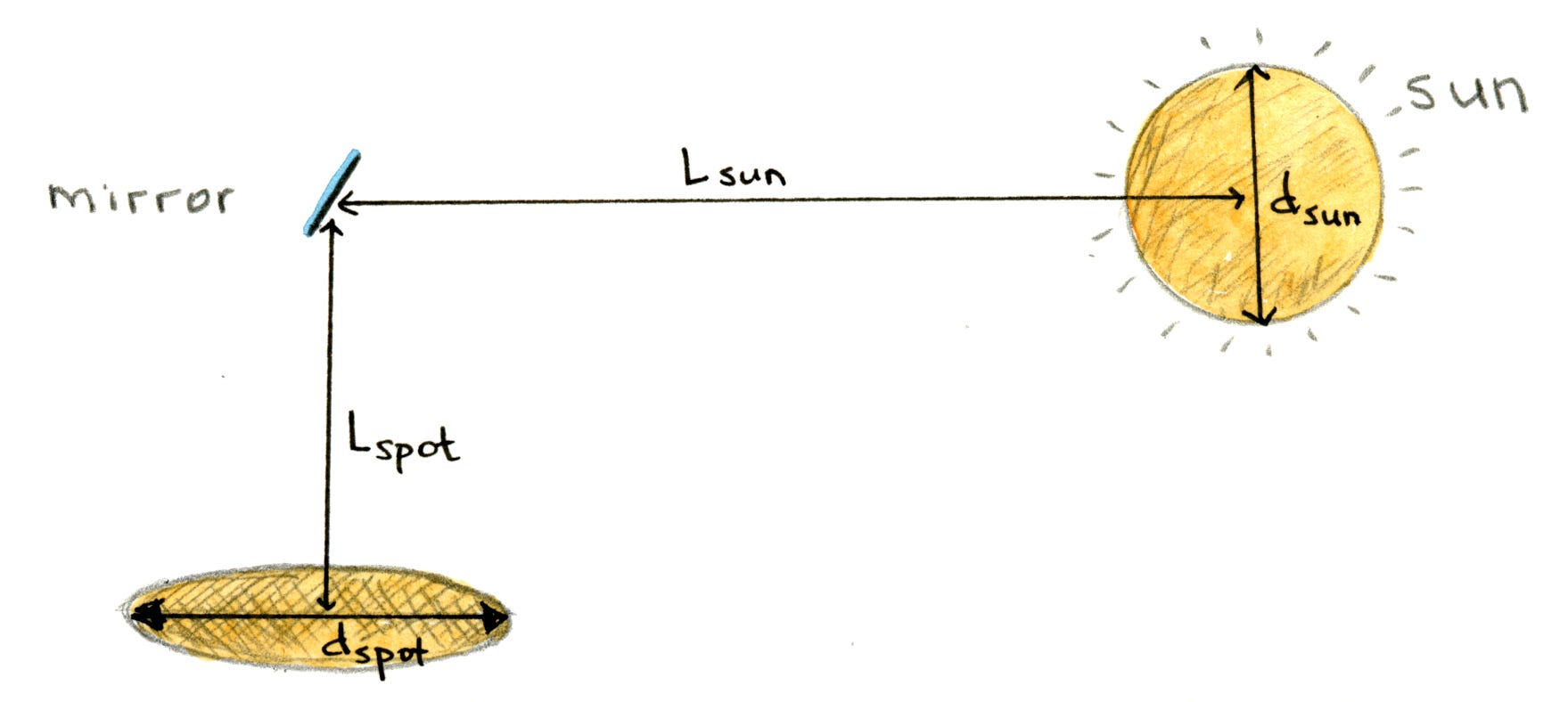
The output spread is similarly related to the diameter of the spot on earth (dspot), and the distance to the spot (Lspot).
Therefore, dspot / Lspot must be at least as large as dsun/ Lsun.
In other words, the diameter of the spot on earth must be at least as large as Lspot x dsun / Lsun .
We know the values of all these parameters: Lsun = 150 x 109 m, dsun = 1.4 x 10⁹ m, and the distance to the mirror, i.e. the height of its orbit, the company tells us is 400 miles (6.4 x 10⁵ m). The spot must therefore be at least 6400 m, or 4 miles, in diameter. . . .
A 3600 square meter space mirror would, at best, dilute 3600 kW of power over a circle 4 miles in diameter, giving a power density at our hypothetical terrestrial solar panels of 0.0001 kW/m2, or 0.1 Watts per square meter. That’s 10,000 times dimmer than noon on a sunny day, and about 100 times brighter than moonlight. . . .
Raghu continues:
But, you might say, 0.1 Watts per square meter is better than nothing. No, in fact, it’s not; it is nothing: solar panels (photovoltaics) won’t generate electricity with such little light input. The resulting currents will be dissipated by inherent resistivity in the device, and the electronics necessary to couple the electricity to other circuitry (inverters, for example) draw far more power than 0.1 Watts per square meter. In fact, 50 Watts per square meter is often stated as a lower limit for the irradiance that can sustain a solar panel. Even if pushed to 10 W/m2, that requirement is 1000 times greater than what our space mirrors could provide, even in the best case.
The notion of solar power from Reflect Orbital’s space mirrors is even more idiotic than it seemed from my first post.
What about non-photovoltaic applications of reflected sunlight? The company notes in the article that the light from space mirrors could “provide light for rescue workers and illuminate city streets.” This is also nonsense. Light is cheap. Developing portable, low-cost light has been one of the great technological triumphs of the past few centuries. As an Our World in Data post shows, “The price of lighting has dropped over 99.9% since 1700”. There is no conceivable scenario by which it makes sense for “rescue workers” to pay $5000/hour for dim Reflect Orbital light rather than paying for spotlights and flashlights, which in addition to being vastly cheaper are brighter and directed.
The question, then, is, what’s the plan? They’ve conned the New York Times, but tech scammers have a pretty good record of manipulating the press (recall Hyperloop and Mars One). Most people have no intuition about physics, nor does anyone have Raghu Parthasarathy on speed dial—he doesn’t even do superstrings! They found a tech investor named Shaun Maguire who apparently is willing to torch his reputation and that of his alma mater (“Caltech physics PhD”) by promoting the product.
As I wrote when this last came up, I have no idea if this company has a business plan beyond burning through VC money and hoping for a government subsidy.
It’s still somewhat of a mystery to me. The company that’s supposed to build and deploy the mirrors . . . they must have lots of physicists and engineers on staff, any of whom would be able and motivated to make the simple calculation demonstrating the impossibility of their plan. They might even come across this post and then they could work through the math themselves!
I guess that with all this VC money they’re getting paid, so, fine, but still. What could it possibly be like to work at such a place? Sure, lots of business plans are iffy or unsustainable, but the laws of physics, they’re tough to get around.
Raghu writes:
Once again one has to wonder whether Reflect Orbital’s scheme is a scam, if the space mirrors are just a gimmick to draw attention before pivoting to a goal that actually makes sense, or if the company and its investors are genuinely ignorant of basic physics. . . . I have written to them to offer my consulting services. I look forward to helping!
All things are possible, and maybe Raghu will end up making a few million from this, in which case I’d say it was all worth it. I don’t know, though. We already know that one of the investors and promoters of the project has a Ph.D. in physics from Caltech and so is presumably not “genuinely ignorant of basic physics.” My guess is that the company is trying to raise as much money as it can and then spend it on something else, maybe do a demonstration project to keep the money flowing as long as they can.
This all came up again a couple days ago when another credulous news story appeared. As Raghu puts it: “Annoyingly, though not surprisingly, the New York Times says nothing about the actual physical infeasibility of the proposal. I guess part of the appeal of these space mirrors is political, as from this comment at Marginal Revolution. Just because some ignorant person likes something, that doesn’t make it a bad idea; the problem here is not with the light pollution or the “enviro loons” but that the physics doesn’t work.
What can be done?
I don’t know. Raghu Parthasarathy is a physics professor at the University of Oregon. Why would the New York Times or any other media outlet care what some University of Oregon professor thinks of anything? They can get alarmists on the phone at any point, but someone who can show that the proposal can’t work . . . that’s just boring, right? That can’t compete with the tech hype. So many people want the tech hype to be true.
Don’t forget, this is the same news-and-social-media world in which some tenured idiot claiming that each scientific citation “is worth a whopping $100,000” promotes himself in Ted talks, a world in which the U.S. government posts that “EVERY TIME WE HIT A NARCO-TRAFFICKING VESSEL, WE SAVE TWENTY-FIVE THOUSAND LIVES”—a claim that’s only slightly less ridiculous than that citation thing, a world in which supposedly skeptical academic podcasters promote bogus claims of mind-body healing.
In some ways, none of this is new. When I was a kid, newspapers had astrology columns, bookstores were selling millions of copies of crap like Chariots of the Gods, they were running TV specials on the search for Noah’s ark, and there was some ambient level of credulous reporting on ESP and UFOs.
What seems different now is that attitude of extreme credulity has worked its way inside the political, academic, and news media establishment:
The federal government is promoting the sorts of stupid-ass claims that in the past would’ve only come from fringe actors such as Joe McCarthy
Professors from Harvard and Stanford are promoting ridiculous scientific claims that in the past would’ve been associated with cranks.
Major media promotes ideas that in the past would’ve appeared in books by uncredentialed charlatans and low-budget shows appearing on UHF channels.
I don’t know what can be done about it. I know some people at the New York Times so I could contact them about the space mirrors story, but the New York Times is a big place, and I doubt my contacts there could have any influence on their tech reporting.
The news media have two kinds of tech stories they like to run: (1) Brilliant tech founders are changing the world and making billions of dollars, and (2) Scary tech is gonna kill us. They’re not so into option (3): Tech investors make tons of money by promising to build something that can’t possibly work.
What’s going on here?
The whole thing is frustrating as hell. People just want to believe. Here we are complaining about space mirrors; meanwhile, the New York Times, Nate Silver, Tyler Cowen, Ezra Klein, etc., are all open to the idea that UFOs are space aliens.
I have a theory that one reason that so many otherwise sensible people (e.g., Alan Turing) in the mid-twentieth century were hardcore ESP believers is that they’d heard about the mysteries of quantum mechanics and “spooky action at a distance” so they thought all things were possible. And, sometimes, yeah, this intuition is correct. Not about ESP, but quantum mechanics was used to invent transistors, and that really did change the world.
In a slightly different way, the immense riches accumulated by tech investors in the past few decades (first it was Steve Jobs and Bill Gates, but now there are thousands of them, too many to count) have given otherwise sensible people the sense that anything is possible, if it has a Silicon Valley connection and enough money is thrown at the problem. And, sometimes, yeah, this intuition is correct. Awesome batteries and solar panels have been built in large-scale production lines, and AI really is amazing. So it’s natural for people to set aside any skepticism and assume that space mirrors for real—after all, there’s Silicon Valley money behind it.
I think that’s the implicit logic being followed by the New York Times reporter and others in the news and social media. They’re open to the idea that this project might be dangerous but not to the idea that it just can’t work as advertised.